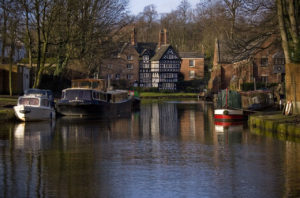
The Bridgewater Canal was constructed when Lord Ellesmere, the Duke of Bridgewater, wanted to transport his coal from his underground mines in Farnworth and Bolton some 10 miles away. The navigation reached Lymm in 1766 and had a profound effect on commerce in the area with the introduction of the fustian (a type of cloth) cutting trade.
If you stop for lunch here, spend a little time looking around this small town. There is a self-guided heritage trail, a pretty village pond and Lymm Cross which represents Queen Victoria’s diamond jubilee in 1897. Half a mile further on, there is a park. Boats can be moored, and there are picnic benches, another good place to stop for lunch.
Where the houses of Grappenhall merge into those of Stockton Heath, there are easy access or get-out points. Stockton Heath, at 7 miles, was the original canal terminus until it was extended to Runcorn, so consequently, it was a major transshipment point for passengers and freight before the railways came.
Walton Hall is a Grade II listed building, owned by Warrington Borough Council. It was built in the 1830s for Sir Gilbert Greenall, a brewer and Member of Parliament. It boasts 32 acres of parkland, Green Flag gardens, and a petting zoo. There are also public toilets here, next to the canal bridge.
Approaching Daresbury, you will spot the distinctive tower of the atomic research facility on your left, with the Mersey Estuary and arch of the Runcorn-Widnes Bridge to your right. Daresbury is the site of some pretty serious research into nuclear physics, particle acceleration, and supercomputers. The levels of security and signage reflect this.
Daresbury is also the birthplace of Charles Lutwidge Dodgson, better known as Lewis Carroll. All Saints church has a pretty memorial window in the Daniell Chapel, where he is shown with the characters of Alice in Wonderland. The new Lewis Carroll Centre celebrating his life is now fully open.
Further useful information can be found on the following websites: