Caldon Canal: Deep Hayes Country Park to Froghall Wharf Paddle Trail

Caldon Canal: Deep Hayes Country Park to Froghall Wharf Paddle Trail

1.5-3.5 hours
Duration
6.5 miles
Distance
One Way
Easy
Difficulty
ST13 7JS
Start Postcode
ST10 2HJ
End Postcode
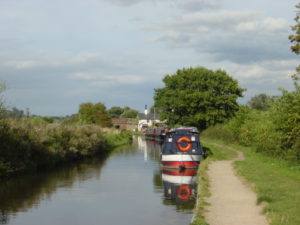
A. Access to the canal is at Bridge 39; launch and turn towards and past the canalside houses; in the direction of Cheddleton. It is a very gentle journey towards the village of Cheddleton.

B. Immediately after the A520 bridge there are two locks to portage, via the towpath on the left. On the right is a small chapel; the birthplace of the Methodist Church in the area.

C. After almost another mile Cheddleton Station and the Boat Inn are reached. The River Churnet flows a few metres away and will follow the canal until they eventually join, just over a mile down river, at Lock 16.

D. At lock 16 the tow path moves to the right bank. Egress left, just before the lock and walk over the humpback bridge to
get in, down a concrete step. For the next mile river and canal follow the same water course.

E. At Consall Forge the river diverges away to the right and tumbles down a large and potentially dangerous weir to a basin 3 metres below.

F. You are around 4 miles into your journey; a good place to take a break or enjoy refreshments at the Black Lion; a quaint, rustic pub. Consall Forge Lime Kilns are set back on the right bank along with an interesting tiled seat memorial. This is part of Consall Nature Park.

G. The railway continues to run alongside the canal and soon Consall Station comes into view. The platform here forces the canal into a narrow channel of just one boat width.

H. Enter Booths Wood. On the canal overflow chutes occur at various points, to allow excess water to flow into the River Churnet. For safety, paddle to the right of the canal, away from them. This is particularly true after bridge 50b, where an incoming stream can cause a large outflow down the 45 degree chute, to the river below.

I. At Flint Lock (no. 17), portage on the left, via the towpath. Note the warning sign and red and white strips at the lock exit gate, which act as a template to ensure boats will fit through Froghall Tunnel.

J. At just over 6 miles the Froghall Tunnel is reached; a low tunnel, 75 yards (68m) in length. Unpowered boats may use this but must have a bright white, forward facing light on each boat. If you do not have this, or would prefer not to paddle, you can portage on the right, via the flat towpath which crosses a main road.

K. The concrete eyesore on the right bank is the demolished remains of Thomas Bolton’s copper works. It’s now only a few hundred metres to your finish point at Froghall Wharf.

Discover More

This is a lovely paddle along through the Churnet Valley, which the canal shares with a heritage railway and the river even shares the same course for a mile. The countryside is mostly either a conservation area, or a site of special scientific interest.

Deep Hayes Country Park is set in a natural bowl in the hillside and is a delightful mixture of woods, meadows, and pools. Originally a reservoir built by the Potteries Water Company to compensate the River Churnet for water extracted by industry lower down the valley, it was finally abandoned in 1979.

Churnet Valley Railway: www.churnet-valley-railway.co.uk is a heritage railway which runs at the weekend and bank holidays along a five-mile restored track from Froghall to Leekbrook.

Just before the bridge under the A520 (at around 1 mile) you will see Cheddleton Flint Mill. This is a fine example of a water mill which ground flint for the pottery industry.

The navigation from Stoke to Froghall is 18 miles long and was originally built as a branch to supply water from the Staffordshire Moorlands to the Trent and Mersey Canal. Its main traffic was transporting limestone from the quarries at Caldon Low to the potteries of the industrial midlands.

Further useful information can be found on the following websites:

Licence Information

The waterways in this trail are managed by the Canal & River Trust, and it is a requirement for paddlers to hold a licence. Paddle UK’s On The Water membership includes an annual licence for here as well as other waterways.

When paddling, have your membership card with you as proof of licence; otherwise, you could face a fine. Get your digital membership card straight away with your licence and liability insurance included from www.paddleuk.org.uk.

JOIN PADDLE UK

Safety Information

We want you to have fun and a safe paddle! Here are some helpful tips to ensure you paddle responsibly and stay safe on your journey. Please take a moment to review these important safety tips:

– Always wear a correctly sized buoyancy aid

– Carry a mobile phone – in a waterproof case

– Tell Someone Where You’re Going

– Check the weather and conditions

– Know your limits

Check out some useful blogs and e-learnings on how to keep safe

Water Safety

Navigation eLearning

Tides eLearning

Weather eLearning

Environment

Wherever and however you paddle, our Paddlers’ Code helps to ensure we can all enjoy and share the water safely and protect our precious environment.

Don’t get sick doing what you love. We know water quality is a concern for many paddlers. Click here for some simple advice on water quality and how to protect yourself.

Get informed, stay safe and make good decisions by checking the National Storm Overflow Map

Paddlers can play a vital role in keeping our waters free of harmful non-native species. It is crucial you Check, Clean and Dry you boat and equipment to prevent the spread. Click here for more information on Invasive Non-Native Species.

For more environmental advice and guidance, see our Blue Space Blogs section on the Paddle UK website.


Video