Basingstoke Canal, Ash Lock to Reading Road Wharf Paddle Trail

Basingstoke Canal, Ash Lock to Reading Road Wharf Paddle Trail

1.5-3 hours
Duration
5.5 miles
Distance
One Way
Easy
Difficulty
GU11 2PS
Start Postcode
GU51 3LS
End Postcode
A. Launch from the low bank above the lock and turn right towards Fleet. Before launching check the visitor
information board on site, this shows a map of your route towards Fleet. Keeping track of the number of bridge crossings you pass is a handy guide to your progress.

B. Along the route you will pass ‘flashes’. These are designated nature reserves, off to the side of the
waterway and boats are requested to keep out.

C. Following the canal for 3 miles, you will come to your fifth bridge; Eelmoor Bridge. This is a good place for a break and if you get out and walk to the road you can get a good view of Farnborough airfield.

D. Just under a mile further is Norris Bridge, a high concrete structure. To your right is the National Gas
Turbine Establishment.

E. After Norris Bridge the canal veers in a westerly direction for ¾ mile before passing under Pondtail Bridge.
You are now entering the outskirts of Fleet.

F. A further mile brings you to the end or turning point of your route; Reading Road Bridge.

Discover More

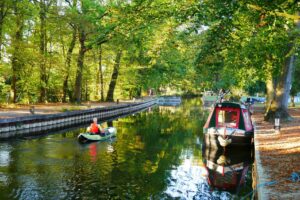
Enjoy a day out on this attractive, lock-free section of canal, surrounded by wooded heathland. This trail can be taken on as a one-way or out-and-back paddle.

The Basingstoke Canal runs for 32 miles, from Greywell Village in Hampshire to Woodham in Surrey. It opened in 1794 to aid the development of agriculture in central Hampshire. By the 1960s, the canal was neglected and no longer navigable. In the 1970s, Surrey and Hampshire County Councils took the canal into public ownership and funded a programme of restoration supported by volunteer work parties. The canal formally reopened in 1991.

The Basingstoke Canal is also a notable wildlife habitat. It has one of the largest varieties of aquatic plants and invertebrates in the U.K. Twenty-five of Britain’s 39 species of dragonflies and damselflies inhabit the canal. The entire length, except for a part through Woking, is an SSSI. Greywell Tunnel, which marks the end of the navigable section, is an internationally important haven for bats.

It is a delightful canal to canoe on, as it feels quite remote, especially in the more western sections. There are many more pubs at or near the waterside than mentioned in the text.

Further useful information can be found on the following websites:

Licence Information

The waterways in this trail are managed by the Basingstoke Canal Authority, and it is a requirement for paddlers to hold a licence. Paddle UK’s On The Water membership includes an annual licence for here as well as other waterways.

When paddling, have your membership card with you as proof of licence; otherwise, you could face a fine. Get your digital membership card straight away with your licence and liability insurance included from www.paddleuk.org.uk.

JOIN PADDLE UK

Safety Information

We want you to have fun and a safe paddle! Here are some helpful tips to ensure you paddle responsibly and stay safe on your journey. Please take a moment to review these important safety tips:

– Always wear a correctly sized buoyancy aid

– Carry a mobile phone – in a waterproof case

– Tell Someone Where You’re Going

– Check the weather and conditions

– Know your limits

Check out some useful blogs and e-learnings on how to keep safe

Water Safety

Navigation eLearning

Tides eLearning

Weather eLearning

Environment

Wherever and however you paddle, our Paddlers’ Code helps to ensure we can all enjoy and share the water safely and protect our precious environment.

Don’t get sick doing what you love. We know water quality is a concern for many paddlers. Click here for some simple advice on water quality and how to protect yourself.

Get informed, stay safe and make good decisions by checking the National Storm Overflow Map

Paddlers can play a vital role in keeping our waters free of harmful non-native species. It is crucial you Check, Clean and Dry you boat and equipment to prevent the spread. Click here for more information on Invasive Non-Native Species.

For more environmental advice and guidance, see our Blue Space Blogs section on the Paddle UK website.


Video